
Blocks
Bring Trim and Control to the Point
Blocks are all about trim, control, and reliable power transmission on board.
When choosing, breaking load, diameter, and compatibility with your existing hardware are important. Ball bearings run smoothly under load, while plain bearings are robust and low-maintenance.
This keeps sail operation precise, smooth, and durable.
Discover variants, materials, and designs that are built for maritime use. This way, you'll find equipment that remains reliable on board - season after season.
Skip to product grid
-
-€0,10

 Vendor:Rutgerson
Rutgerson Deck Organizer Aluminum - anodized, with Delrin sheaves
Regular price From €104,80Regular price€104,90-€0,10 Sale price From €104,80 -
-€0,10

 Vendor:Rutgerson
Rutgerson Deck Block Aluminum – heavy-duty single sheave deck block with plain bearing
Regular price From €364,80Regular price€364,90-€0,10 Sale price From €364,80 -
-€0,10

 Vendor:Rutgerson
Rutgerson Deck Block Type 80 Aluminum – Double Sheave with Plain Bearing
Regular price €630,80Regular price€630,90-€0,10 Sale price €630,80 -
 Vendor:Gotthardt
Gotthardt Swivel Block for Furling Line – Block with 25mm Swivel
Regular price €12,50Regular price€12,50Sale price €12,50 -
 Vendor:Gotthardt
Gotthardt Diverter Block for Roller Furling System - Stainless Steel Stanchion Mounting
Regular price €70,50Regular price€70,50Sale price €70,50 -
-€0,10

 Vendor:Rutgerson
Rutgerson Deck Block Plastic with Clamp – single sheave, high working load
Regular price From €78,40Regular price€78,50-€0,10 Sale price From €78,40 -
-€0,10

 Vendor:Selden
Seldén Low Friction Ring – lightweight aluminum fairlead ring
Regular price From €14,40Regular price€14,50-€0,10 Sale price From €14,40 -

 Vendor:Rutgerson
Rutgerson StandUp Block ball joint onDeck - self-aligning deck block
Regular price From €526,90Regular price€526,90Sale price From €526,90 -
-€0,10
 Vendor:Rutgerson
Rutgerson Block with fixed toggle head – single sheave plain bearing block
Regular price From €33,80Regular price€33,90-€0,10 Sale price From €33,80 -

 Vendor:Rutgerson
Rutgerson StandUp Block Ball Joint onDeck – Self-Aligning Deck Block
Regular price From €526,90Regular price€526,90Sale price From €526,90 -
 Vendor:Rutgerson
Rutgerson Block with Swivel Toggle Head – Single Sheave Plain Bearing Block
Regular price From €34,50Regular price€34,50Sale price From €34,50 -
-€0,10

 Vendor:Selden
Seldén BBB StandUp Block – single sheave ball bearing block with head strap
Regular price From €17,80Regular price€17,90-€0,10 Sale price From €17,80 -
-€0,10

 Vendor:Rutgerson
Rutgerson ROC Block – ball-bearing high-load block with needle-bearing axle
Regular price From €310,80Regular price€310,90-€0,10 Sale price From €310,80 -
-€0,10

 Vendor:Rutgerson
Rutgerson Double Deck Block Aluminum Type 100 with Cam Cleat
Regular price €628,80Regular price€628,90-€0,10 Sale price €628,80 -
-€0,10

 Vendor:Rutgerson
Rutgerson Deck Block Plastic Type 80 Cruising – single with plain bearing
Regular price €117,80Regular price€117,90-€0,10 Sale price €117,80 -
 Vendor:Selden
Seldén Double Snap Shackle with Swivel – Stainless Steel
Regular price €154,90Regular price€154,90Sale price €154,90 -
-€8,20
 Vendor:Selden
Seldén BBB60 Double Ball Bearing Block with Swivel Shackle
Regular price €117,70Regular price€125,90-€8,20 Sale price €117,70 -
 Vendor:Selden
Seldén Snap Shackle for Spinnaker/Genoa Halyard - Stainless Steel
Regular price €93,50Regular price€93,50Sale price €93,50 -
-€0,10

 Vendor:Rutgerson
Rutgerson Deck Block with Plain Bearing – High-Load Single Sheave Block Made of Plastic
Regular price From €50,80Regular price€50,90-€0,10 Sale price From €50,80 -
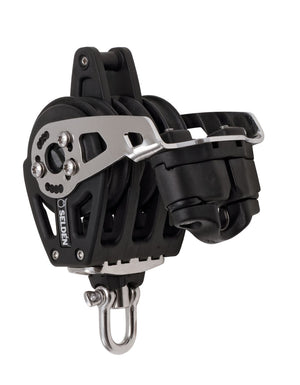 Vendor:Selden
Seldén Three-Disc Ball Bearing Manual Ratchet Block MRB60 with Swivel Shackle, Bottom Bracket and Clamp
Regular price €268,90Regular price€268,90Sale price €268,90


Deine Fragen / Unsere Antworte
- How do I know which rope diameter fits a block?
- Every block specifies a maximum rope diameter for the sheave. Use this value as an upper limit – a rope that runs loosely in the sheave is better than one that jams or touches the edge. When in doubt, it's better to choose a sheave size larger.
- Can I simply replace a ball bearing block with a plain bearing block if the attachment is the same?
- Yes, provided that the breaking load and sheave diameter are comparable. However, keep in mind that plain bearing blocks generate more friction under high loads – this can make operation noticeably more difficult on heavily loaded sheets.
- What does 'Working Load' mean compared to the breaking load for blocks?
- The breaking load is the value at which the block fails. The working load – often a fraction of that – is the load for which the block is designed for continuous operation. For selection, you should compare the working load with the actual force occurring in your system, not the breaking load.
- My block runs heavily, even though the rope fits – what can I do?
- Rinse the block thoroughly with fresh water and turn the sheave by hand. Salt crystals between the sheave and the housing are the most common cause. If this doesn't help, check whether the sheave is cracked or the bearing is corroded – in that case, a replacement is more sensible than further attempts with lubricants.